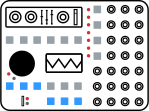
Register
A shift register.
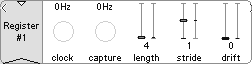
A shift register that can hold up to 64 steps of arbitrary voltages with a built in random source to sample from.
Samples values from the unit input whenever the capture gate is triggered and adds a random value scaled by scatter to the value before storing it in the currently active step.
Serves as the basis for the more specialized units turing and seq.
| Input | Description |
|---|---|
| unit input | The input signal to record. |
| clock | Advance by stride steps. |
| capture | Store the unit input plus some randomness scaled by scatter. |
| length | The total number of steps in the register, up to a maximum of 64. |
| stride | The number of steps to advance on each clock or shift trigger. |
| drift | Add slight random variation to the stored step values when non zero. Returns to the original stored value when zero. |
| shift | Shift the register by stride steps. |
| reset | Reset the current step to the head of the register. |
| gain | Input gain. |
| bias | Input bias. |
| scatter | Randomness added to the unit input on capture and set all/window. |
| Menu Item | Description |
|---|---|
| Clock Sync | shift: synchronize shift triggers to the clock. capture: synchronize capture triggers to the clock. reset: synchronize reset triggers to the clock. |
| Set all | zero: set all stored values to zero. scatter: add randomness to all stored values scaled by the scatter control. zero + scatter: set all stored values to zero and then scatter them. |
| Set window | zero: set the current window to zero. That is, step through the register using the current length and stride and set each value. scatter: add randomness to all stored values in the current window. zero + scatter: set the current window to zero and then scatter it. |